
By CareMotion · Musculoskeletal Care
Understanding Rotator Cuff Impingement and Tendinopathy
The rotator cuff is a dynamic team of four deep muscles—supraspinatus, infraspinatus, teres minor, and subscapularis—that stabilize the humeral head centrally inside the shallow glenoid socket during arm movement.
Rotator cuff tendinopathy (often termed subacromial impingement) occurs when the supraspinatus tendon becomes compressed or irritated beneath the bony acromion arch, typically between 60 and 120 degrees of arm elevation (the 'painful arc').
- Aching pain in the outer upper arm, especially when lifting the arm overhead or reaching into a car back seat.
- Difficulty sleeping on the affected shoulder due to throbbing night discomfort.
- Loss of active elevation strength while passive movement remains relatively free.
Phase-Based Rotator Cuff Rehabilitation Protocol
Rehabilitation begins by de-loading the irritated subacromial space: calming acute bursitis and releasing tight pectoralis minor and upper trapezius muscles that tilt the scapula forward into an impingement angle.
Next, targeted rotator cuff isometric and eccentric strengthening with elastic resistance bands draws the humeral head downward, opening the subacromial space during overhead arm elevation.
- Isometric shoulder external rotation against a doorframe with a rolled towel tucked under the elbow.
- Side-lying external rotations with a light 1 kg dumbbell targeting infraspinatus and teres minor.
- Scapular setting exercises ('scaption' and prone Y-to-T raises) to build serratus anterior and lower trapezius control.
Overhead Ergonomics and In-Home Shoulder Physiotherapy
Reaching for heavy kitchen storage items overhead or hanging clothes on high apartment balcony wires in Kolkata can chronically irritate healing tendons. Rearranging storage so frequent items sit between chest and waist height is vital.
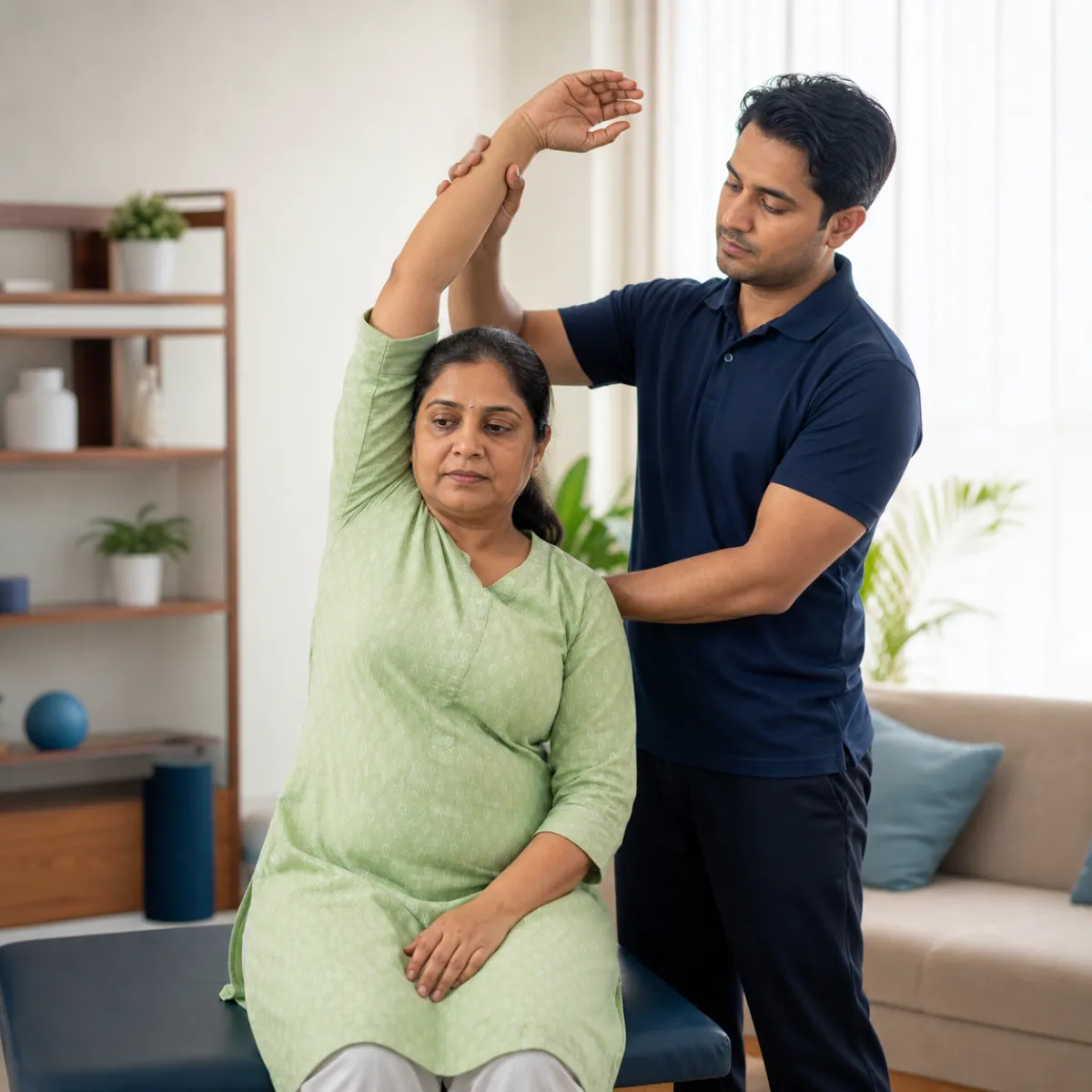
CareMotion physiotherapists assess shoulder joint kinematics, evaluate rotator cuff integrity, and deliver progressive home rehabilitation programs.
- Always keep a small rolled towel between your elbow and ribcage during rotator cuff band exercises.
- Avoid upright rows or behind-the-neck lat pulldowns at the gym that jam the acromion.
- Sleep on your back or on the uninjured side with a pillow supporting the symptomatic arm in front.
General information to help you plan a visit. Individual assessment and your treating team's advice guide rehabilitation decisions.